

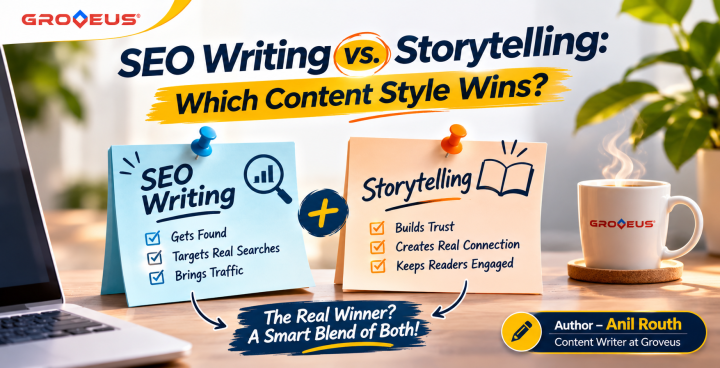
Discover the difference between SEO writing and storytelling, and learn how combining keyword research, engaging content, and real-life examples can improve search visibility, build reader trust, and keep audiences engaged.
Open almost any blog and you’ll find one of two problems. Some posts read like a keyword list with punctuation. Others read like a diary entry about "our journey." The first gets found and ignored. The second gets admired by the three people who happen to stumble on it.
Both are fixable, and the fix is less dramatic than people expect.
SEO writing is a search problem
Before writing, you check what people type into Google. Not what you think they type. Someone who runs a clinic might want to rank for "advanced patient care solutions," while patients are searching "dentist open Sunday near me." Writing for the second phrase is SEO writing.
From there the work is mostly practical: the phrase in the title and first paragraph, subheadings that match real questions, a meta description that gives someone a reason to click. It's unglamorous, and it works.
Where it goes wrong is when that's all there is. A page built purely around keywords answers the question, technically, and gives the reader nothing to trust.
Storytelling is a trust problem
Take a line like "we build fast websites." Every business says it, so it carries almost no weight. Now say a furniture store's product pages took nine seconds to load on mobile, shoppers left before the photos appeared, and trimming the images cut the load time to under three. That's a specific situation with a before and after, and it does what a claim can't.
You don't need a villain or a hero's arc. A single concrete example is enough.
The weakness is plain, though. A good example on a page that never appears in search results helps nobody.
Why the two get confused
Somewhere along the way writers started picking sides: the keyword people on one side, the “good writing” people on the other. The split has never made much sense. SEO wants the main phrase high up and clear headings, and a story likes to take its time. But a heading can carry the keyword while the paragraph under it does whatever it likes. That’s the whole conflict.
What gets missed is that they help each other. A post people actually read has a better shot at being shared, cited and linked over time, and that can help it get seen.
Using both without overthinking it
Search your target phrase in Google before you write a word, and actually read the top three pages. Most of them repeat each other, and what none of them mention is usually the thing a reader would have wanted to know. Put your example there. It’s also the easiest way to stop your post from sounding like the other nine.
For the headline, write it the way you’d say it out loud to a friend, then check if the keyword is still in there. “7 Writing Fixes That Keep Readers Scrolling” passes. “Blog Writing Tips Best Practices 2026” reads like a file name.
Skip any opening about how digital marketing keeps evolving. Begin with the real problem instead, like a contact form nobody fills in, and go from there.
Small screens make long paragraphs tiring, so keep them brief and don’t give a section more than one example. Piling on three makes the post drag. At the end, point readers to something they can do or read next, such as a related guide or a quick checklist.
As a starting point, give the structure most of the attention and use storytelling where it adds something real. The balance depends on the subject and the reader. A post for first-time buyers can handle more story. One for developers probably can’t.
Habits worth dropping
Repeating the keyword every other sentence. It reads badly, and Google stopped rewarding it a long time ago.
Hiding the steps. If the search was “how to,” people want the steps up front, and the backstory can wait.
A page that tries to rank and sell at the same time, without knowing what the reader came for, often does neither well. Decide the page’s main job before you start writing. If someone searched “how to fix a slow website,” they want the fix first. The pitch can come after, once they’ve got what they came for.
So, which one?
Both. SEO gets the right person to the page, and storytelling is why they believe you once they’re there. Skip either and you’ve got half a blog.
Comments 0