

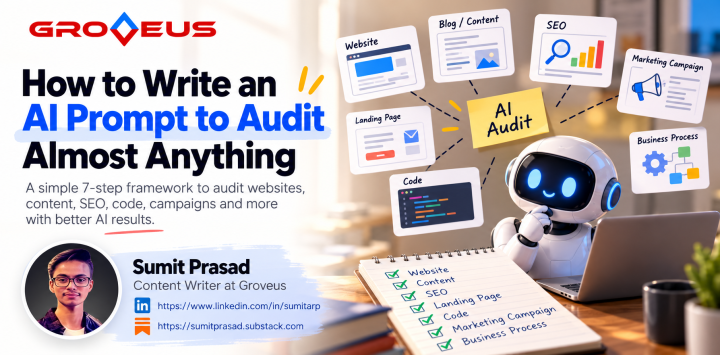
How to write an AI audit prompt using a simple 7-step framework. Audit websites, SEO, content, code, landing pages and business processes with better results. Get a free master audit prompt as well.
How to Write an AI Prompt to Audit Almost Anything (A 7-Step Framework)
You can ask AI to audit almost anything. It can be a website, a blog, a landing page, a piece of code, or a marketing campaign. You can even audit your business process. But there is one problem.
If you only say, “Audit this,” you will get a long answer that looks useful but helps you with nothing. It will point out 20 things; you will read all of them and still not know what you should fix first. I think the problem is not always AI. The problem is the instruction you give it.
An audit is not only about finding things that look wrong. An audit is finding problems against something. You need to know what you are checking, why you are checking it, what evidence you have, and what should happen after you find a problem.
That is why I don't think you need a separate complicated prompt for every audit. You need a clear structure. And once you understand that structure, you can use it for almost anything.
Don't Just Ask ChatGPT “Audit This”
Let's take an example. You have written a service page and want AI to review it. You could write: “Audit this service page and tell me what is wrong.”
This looks fine. But what exactly it should check?
You want it to check SEO, writing, search intent, trust, conversions, readability, structure, local relevance. You haven't told it. So AI has to decide for itself. And that is where the audit can become weak.
Now change your prompt to: “Audit this service page for search intent, content clarity, SEO, trust signals, structure and conversion issues. For every issue, show the evidence from the page, explain why it matters and suggest a specific improvement. Prioritise the findings as high, medium or low.”
This time, AI or your ChatGPT has a job. It knows what to inspect. It knows what to look for. It knows what evidence to use. And it knows how you want the answer. That is the difference, you know.
A good audit prompt is less about asking AI to be “smart”. It is about giving it a clear job to do.
A 7-Step Framework To Have A Good Audit Prompt
I think a useful audit prompt can be built around seven things:
Subject --> Goal --> Context --> Criteria --> Evidence --> Output --> Priority
That's it. You don't need to make every prompt 500 words. Let's break this down. Also, I’ll give you a free master audit prompt at the end of this article.

Tell AI What You Want to Audit
First, define the subject. Don't say: “Audit this.”
Say: “Audit this homepage.”
Or: “Audit this blog article.”
Or: “Audit this SEO landing page.”
Or: “Audit this PHP code.”
It sounds obvious. But this gives AI a starting point. The more specific the subject is, the easier it becomes to decide what should be checked.
Tell It What You Want to Achieve
An audit without a goal can become a list of random observations. For example, you have a landing page. Your goal could be to improve conversions. Or it could be to improve search visibility. These are not the same thing. So tell it to AI.
For example: “The goal is to make this page clearer for first-time visitors and improve the chances of generating enquiries.”
Now the audit has a direction. It is no longer only looking for mistakes. It is looking for problems related to your actual goal.
Give It Context
This is one part you’ll skip. AI doesn't know everything about your business, audience or situation unless you tell it.
Suppose you are auditing a page for a logistics company.
You can tell it: “The page targets people looking for house shifting services in Kolkata. Most visitors are likely comparing service providers before making an enquiry.”
This one piece of context changes the audit. The same page could be acceptable for one audience and poor for another.
Context tells AI what the material is supposed to do.
Tell It What to Check
This is where your actual audit framework comes in. For a content audit, you may ask AI to check:
Accuracy
Clarity
Structure
Repetition
Readability
Search intent
Usefulness
For an SEO audit:
Search intent
Title and headings
Internal links
Content coverage
Keyword relevance
Trust signals
On-page issues
For a website:
Navigation
Content clarity
User experience
Trust
Calls to action
Mobile usability
Don't say: “Find everything wrong.” Tell it what “everything” means for your particular audit.
Ask for Evidence
This is the most important part. Don't ask only: “What's wrong?” Ask: “What evidence supports your finding?”
Why? Because there is a big difference between an observation and an assumption.
For example: Weak finding: “The website has poor Core Web Vitals.”
Did AI actually measure them? If not, it shouldn't make that statement.
A better finding would be: “I cannot assess Core Web Vitals from the provided content because no performance data is available.”
That is much more useful. The same applies to content.
Instead of: “The introduction is weak.” Ask it to show why.
Maybe the introduction doesn't explain what the page is about. Maybe it takes three paragraphs to reach the main point. Maybe it doesn't match the search intent.
Now you have something you can work with. An audit should be connected to evidence. Otherwise, it slowly becomes an opinion.
Decide How You Want the Output
You can have a good audit and still get a difficult answer. Why? Because you didn't tell AI how to organize it.
For example, you can ask for:
Issue --> Evidence --> Why it matters --> Recommendation --> Priority
This is much easier to work with. Instead of getting: “The page could improve its content, structure and CTA.” You get:
Issue: CTA is not clear in the opening section.
Evidence: The first section explains the service but does not provide a clear next action.
Why it matters: A visitor who is ready to enquire may not immediately know what to do.
Recommendation: Add a clear enquiry action after the opening section.
Priority: High.
Now the audit has become a working document. Not just feedback.
Ask to Prioritize
This is another thing I find useful. Not every problem deserves the same attention. If AI finds 25 issues, you don't want to fix all 25 at once.
Some will be important. Some will be minor. Some will not even need fixing. So ask AI to prioritize them. For example:
High: Fix first because it directly affects the audit goal.
Medium: Worth fixing but not urgent.
Low: Improvement that can be considered later.
This turns an audit into an action plan. And that is what you need from an audit. You don't need a longer list of problems. You need to know:
What is wrong? Why does it matter? What should I do about it?
The Same Framework Works for Almost Anything
This is where I think the framework becomes interesting. Let's say you want to audit an SEO page. Your criteria could be search intent, content coverage, internal linking and on-page SEO.
Now suppose you want to audit a marketing campaign. The criteria can change to audience, messaging, offer, creative, channel and business objective.
Want to audit code? Change the criteria to bugs, security, performance, readability and maintainability.
Want to audit a resume? Change them to relevance, clarity, achievements, structure and role alignment.
The subject changes. The criteria change. But the thinking stays almost the same. That is why I prefer a framework over a collection of 100 prompts.
And as promised, here is the master audit prompt you are looking for. Click here to download it.
Comments 0