

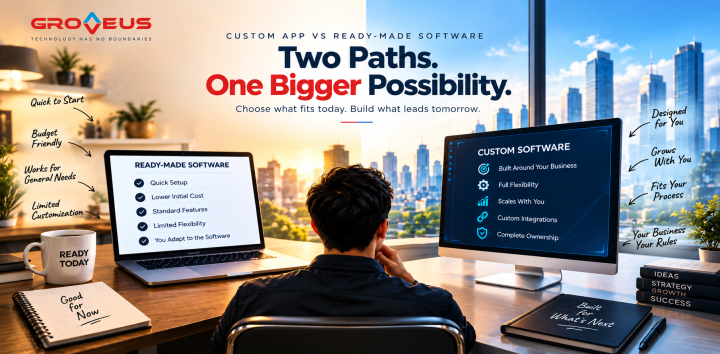
Custom software vs ready-made software: compare cost, flexibility, scalability, integrations, security, and business needs to choose the right solution.
Running a business today means relying on software for almost everything - managing customers, tracking sales, handling payments, keeping tabs on employees, processing orders, pulling reports, and a dozen other things you probably didn't expect to need software for when you started out.
Sooner or later, most businesses hit the same fork in the road: do we buy something that already exists, or do we get something built specifically for us?
Ready-made software looks like the obvious answer at first. It's already built, usually cheaper to get started with, and you can be up and running within a day or two. But as the business grows, things tend to get messier. You start bending your own processes to fit the software instead of the other way around. Features you actually need aren't there, while you're paying for a bunch you'll never touch. And connecting it to your other systems? Sometimes it just doesn't want to cooperate.
That's usually the point where custom software enters the conversation.
So which one wins? Honestly, neither does automatically. It really comes down to your business, what you actually need, and where you're trying to go over the next few years. Let's go through it properly.
What Is Ready-Made Software?
Ready-made software is a product built once and sold to a large number of businesses - think accounting tools, CRMs, project management apps, communication platforms, inventory systems, and the endless list of subscription-based tools out there. You pick a plan, set up an account, tweak a few settings, and you're off.
Why Businesses Go This Route
Mostly, it's convenience. You're not sitting through months of requirement discussions or waiting on a dev team to hand something over. Instead, you can:
Start using it almost right away
Pay a monthly or yearly fee
Get updates without lifting a finger
Use features that are already sitting there, ready to go
Reach out to the provider whenever something breaks
For a small business with fairly ordinary needs, this is often the right call. There's no good reason to build your own CRM from the ground up if an existing one already covers everything your team needs.
What Is Custom Software?
Custom software, on the other hand, is built around your business specifically. Rather than reshaping how you work to match some generic product, the software is designed to fit the way you already operate.
Say you run a distribution business. Your salespeople visit retailers, log orders on the spot, chase pending payments, keep track of promised payment dates, and need separate reports for each salesperson. You could try to hold all of that together with spreadsheets and a handful of unrelated apps. Or you could have one system built where salespeople log visits and orders directly, managers keep an eye on outstanding payments, and the owner sees the whole picture from a single dashboard.
That's really the whole idea behind custom software - it's shaped around what you need, not around what someone else decided a "typical" business needs.
The Real Difference Between the Two
It isn't just about price. The gap comes down to control, flexibility, how well the software scales with you, and how closely it actually fits the way you work. Here's a quick side-by-side:
That table doesn't tell you much on its own, though. What matters is what these differences mean once you're actually running the business day to day.
1. Cost Isn't as Simple as It Looks
This is where a lot of businesses get the comparison wrong. A ready-made tool might run you 1,000 or 5,000 a month, while a custom build could mean a much bigger check upfront. On paper, ready-made wins easily.
But look past the sticker price. If your business is stitching together five different tools because no single product does everything you need, you're paying five subscriptions every month - plus the hidden cost of manual data entry, exporting and importing files between systems, training staff on each one, and keeping several platforms running at once.
A custom application might cost more to start, but it could fold several of those processes into one place. That doesn't automatically make custom cheaper - it just means the lowest price today isn't necessarily the cheapest option three years from now.
2. Can the Software Actually Work the Way You Do?
This is probably the biggest gap between the two. With ready-made software, you get whatever features the provider decided to build. You can adjust some settings, sure, but only within limits they've set.
Say your approval process needs to go: Employee Sales Manager ? Regional Manager ? Finance ? Final Approval. A standard product might only support a simple Employee, Manager ? Approval chain. If it doesn't stretch to fit your process, you're stuck either finding a workaround or changing how your business actually operates.
Custom software can be built around the process you already have. For businesses with an unusual or specific workflow, that's a real advantage.
3. Sometimes Speed Just Wins
This is where ready-made software has the edge, no argument. If you need a working CRM by tomorrow, building one from scratch makes no sense at all. Grab an existing one and get your team moving.
The same logic applies to plenty of common business needs - if something out there already solves your problem well, use it. Building software just because you technically could isn't a strategy. Custom development earns its place when the existing options genuinely fall short.
4. Think About Where the Business Is Headed
Whatever you choose shouldn't become the thing holding you back later. A setup that handles ten employees fine might buckle at a hundred. A basic order system that's comfortable at 50 orders a day could turn into a bottleneck once you're handling thousands.
Ask yourself honestly: will this still work two or three years from now? If yes, ready-made is probably fine. If you already sense your needs are going to get more complicated, custom software gives you more room to grow into.
5. Integrations Can Flip the Whole Decision
Most businesses aren't running just one piece of software. You're probably juggling a CRM, accounting software, a payment gateway, a website, maybe a mobile app, an inventory system, email marketing, WhatsApp, an ERP, and a few internal dashboards for good measure.
The trouble starts when none of these talk to each other properly, and your team ends up copying information from one system into another by hand - which wastes time and opens the door to mistakes.
Custom software can be built with those specific integrations baked in from the start, so systems exchange information without anyone touching a keyboard. To be fair, plenty of ready-made products offer solid APIs too. The real question isn't "is custom better" - it's whether the integrations you actually need are even possible before you commit to a platform.
6. Security Is Easy to Overlook
This one gets missed a lot. With a ready-made SaaS product, your data lives inside that provider's infrastructure, under their security practices and their terms. For most businesses, that's perfectly fine. But if you're dealing with sensitive data or specific compliance requirements, you might need more say over how things are handled.
Custom software can be built around your exact security needs - but here's the catch: it isn't automatically more secure just because it's custom. A poorly built custom system can be far less secure than a mature, well-established commercial platform. Security comes down to architecture, development practices, infrastructure, access controls, monitoring, and ongoing maintenance - not who built it.
7. What Happens When Your Business Changes?
Businesses evolve. You might add a new service, expand to another city, bring on a new sales team, rework your pricing, or overhaul how orders get handled. With ready-made software, you're at the mercy of whether the provider decides to support that change. Sometimes they do. Sometimes the feature you're waiting on shows up six months late, if at all.
Custom software puts you back in control - you can keep developing the system as the business shifts. That freedom comes with a responsibility, though: it needs ongoing maintenance, updates, and occasional new development. It's not something you build once and forget about.
When Ready-Made Software Makes Sense
Lean toward ready-made if:
Your needs are fairly standard
You need something running quickly
Budget is tight
An existing product already does the job
You don't need much customization
You don't need unusual integrations
You're still testing out a business idea
If you're just starting out and need basic accounting, there's little point spending a fortune building your own system. Use what's already out there and put your energy into growing the business instead.
When Custom Software Makes More Sense
Custom development starts to make sense when:
Your workflows are genuinely unique
Nothing off-the-shelf covers what you need
Multiple systems need to work together
You want full control over the user experience
The business is growing fast
You need specialized reporting or dashboards
A lot of your work is still manual
You need something customer- or employee-facing
Deep integration with your existing systems matters
A logistics company, for example, might need route planning, driver tracking, order allocation, customer notifications, payment tracking, and an admin dashboard all in one place. Trying to force that mix into a bunch of unrelated tools usually creates more headaches than it solves - a custom platform tends to make far more sense here.
What About a Mobile App Specifically?
The same logic carries over to mobile apps. You don't need one just because a competitor has one. It makes sense when customers or employees genuinely need to interact with your business through their phones often.
A grocery business might want customers browsing products, ordering, paying, and tracking delivery from an app. A travel company might need customers searching packages, booking, paying, and managing trips. A sales team might need to manage customers, orders, and follow-ups while out in the field. A service business might want appointment booking and service tracking built in.
But if people only visit your platform occasionally, a well-built website is probably the more practical choice. The technology should follow what the business actually needs - not the other way around.
A Simple Way to Decide
Before spending a rupee on development, sit down and answer these:
Does something already solve this problem? If yes, try it properly before jumping into custom development.
How unusual are your processes, really? The stranger your workflow, the more valuable customization becomes.
How much manual work is happening right now? If your team is constantly shuffling data between spreadsheets and apps, that's usually a sign automation would help.
Will your needs change a lot as you grow? If big changes are coming, flexibility matters more.
What will this cost over the next 3–5 years? Don't just compare the sticker price - factor in training, subscriptions, integrations, manual work, maintenance, and lost productivity.
So, Which Should You Pick?
There's no one-size-fits-all answer here. Go with ready-made software when your needs are common and something out there already does the job well. Go custom when your business has specific requirements that off-the-shelf products just can't handle properly.
And often, the smartest move is a mix of both - a ready-made accounting platform, a third-party payment gateway, and a custom application tying it all together. That's usually a far better approach than trying to build every single piece from scratch.
The goal was never to build more software. It's to end up with the right software for the problem you're actually trying to solve.
Final Thought
Technology should make running your business simpler, not more complicated. If an existing tool solves your problem, use it. If you keep finding yourself working around its limits, that's your cue to start thinking about a custom solution.
And if you're still not sure, don't start with "should we build an app?" Start with "what problem are we actually trying to solve?" Once that's clear, the right choice usually follows on its own.
Need Software Built Around Your Business?
Every business runs a little differently. If the tools out there don't quite fit how yours operates, a custom web application, mobile app, CRM, or business management system might be the better route.
Our team can help you figure out what you actually need, pick the right technology, and build something designed around how your business really works.
Comments 0