

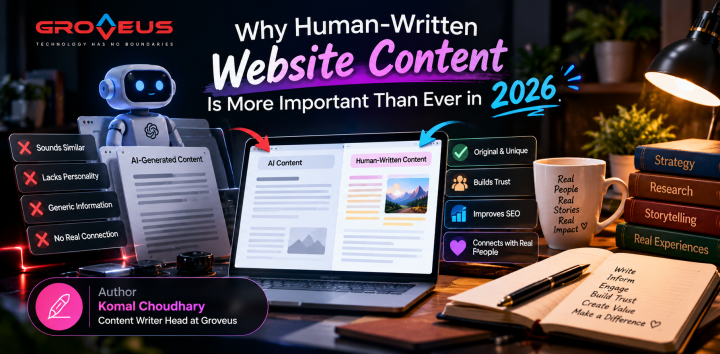
Discover why human-written website content matters in 2026 and how originality, expertise, personality, research, and clear communication can build trust, engagement, and stronger SEO.
It would be hard to find an internet page without blog posts, service description and other content. However, there is a downside - as soon as everyone starts sounding alike, no one listens anymore.
That is one of the key reasons why human-written content on websites is so important in 2026.
Modern businesses depends on AI tools for coming up with drafts, inspiration and a lot of texts. AI technology saves time but posting anything that came from it is not the same as writing something that customers would enjoy reading. A human writer brings expertise, judgement, research, personality and knowledge of what a client actually needs.
Consider the webpages that stuck with you. They are not those that use the most sophisticated vocabulary. Rather, those that explained something in simple terms, answered your questions or helped you see there is a human behind the business.
Here is what good website content can do for the company:
Describe its services without leaving the clients confused
Answer the clients' questions before they decide to contact you
Build trust via informative and unique content
Make the search engines understand what the site is all about
Establish a distinctive voice for the brand
Google also kept encouraging the people-focused approach in website content that provides real value instead of filling the page with keywords. That is why the quality of writing becomes more crucial than just publishing lots of articles.
There is even more difference between two businesses offering the same thing. Both of them may call themselves "professional" and "reliable", yet only the company that describes its services, informs about them and uses clear language has more chances to engage with its clients.
Marketing writers such as Seth Godin and Ann Handley talked for years about the importance of meaningful communication, storytelling and writing for real people. Their works reflect a principle that remains true in 2026 - you do not have to be noticeable. You have to say something.
Human writing does not have to exclude technology. Writers can use research tools such as Google Trends to understand what people are searching for, Google Search Console to see which queries are bringing visitors to a website, and tools such as Google Analytics to understand how people interact with their content. AI-assisted software can also help with ideas, research and early drafts. What matters is that the writer still checks the information, adds their own judgement and keeps their natural writing style at the centre of the final piece.
In 2026, that balance is important.
The webpage should not look like keywords connected into sentences. It should look like a dialogue between the business and its potential customers.
AI may help to write content faster. Thinking is what makes it worth reading.
Comments 0