

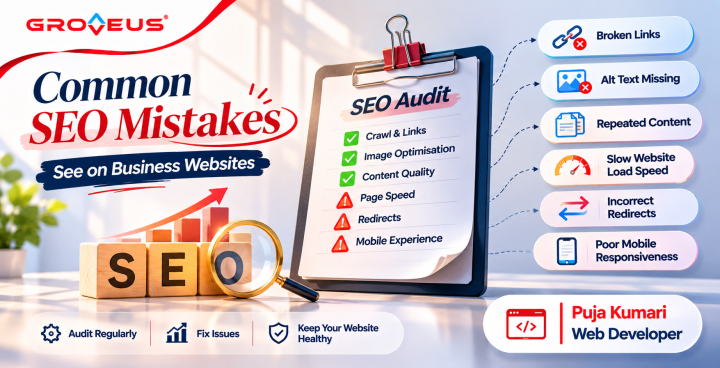
Common SEO mistakes that can affect your business website's performance. Learn how broken links, missing image alt text, duplicate content, slow loading speed and incorrect redirects impact user experience and search visibility.
Despite having good web design, there may be issues. There may be duplicate pages, missing descriptions, or incorrect redirects. Some URLs may lead to a 404 page. Although these are small issues, they can greatly affect user experience.
Here are some common SEO mistakes that affect websites:
Broken Links
Broken links are a very common issue. This may occur due to pages being removed, URLs changing, or incorrect links being added. As a result of this, users may get a 404 page. To avoid this, check for any outdated links and new URLs.
Alt Text Missing
Images are an important part of a website, it makes them more attractive , but adding images is not enough. They also need proper alt text. Alt text describes the image and helps search engines understand what it represents. It's also helpful for both search engines and user who use screen reader
For example, an image showing a person packing furniture can have description related to the packing activity
Repeated Content
Although repeated content may be accidental, it may occur frequently. If pages have been made from other pages as templates, such as service pages for different locations, there may be repeated heading, descriptions and paragraphs. Only a few words may be changed. To prevent unnecessary repetition in pages, check through the pages and include relevant information. If multiple pages have identical/similar content, canonical tags can be added.
Slow Website Load Speed
It is frustrating for users if a website takes a long to load. As a result, users may leave the page and try a different website. Large images, extra scripts and poor performance from the web host may cause slow loading speeds.
Incorrect Redirects
Redirects can be useful if pages are removed, moved or renamed. However, redirects may not be correct. Multiple URLs may be required to get to the right page, which may delay getting to the final destination. Generally, 301 redirects should be used in situations of permanent URL changes.
Poor Mobile Responsiveness
Even though a website may have good design on a desktop device, it may perform badly on mobile devices. Text may be too small, elements may not show correctly and buttons may be hard to press. These issues are common and may mean users leave the page.
How to Prevent These Issues
Most of these issues can be improved by regularly auditing the site. By making sure all URLs are working, images have alt text, correct redirects, accurate content and good performance (desktop and mobile) within the site, we can prevent these issues.
Key Takeaways
SEO is not simply about adding keywords and creating new pages. The technical performance within the site also plays an important part.
Issues such as broken links, missing alt text, repeated content and slow loading speeds can be problematic for users and may cause problems in how search engines perceive the site.
By performing regular audits and collaborating between SEO and development, we can pick up these issues quickly and keep sites in good health.
Keeping the site in good health means a better user experience, and therefore a strong SEO base in the long run.
Comments 0