

Ever wondered what happens to your data when you use an app? Understand how front-end, back-end and databases work together to store, retrieve, manage and protect information behind everyday applications.
When you open an app, you only see the screen in front of you. There are buttons to tap, forms to fill and information to read. The work happening behind that screen is easy to forget. The app has to remember things, find the right information and sometimes change it, all while you're using it.
When developing web applications, this must be considered. In an appointment booking system, once a user has selected a date, put their details in and clicked a book, the information should be stored so that it can be viewed at a later date by the business and customer.
So where does that information go?
Most commonly, data is stored in databases. Different apps will store different data. Within the appointment booking app, a database could contain the name of the user, their contact details, the date of their appointment, and whether they have made a booking. Within a shopping app, a database could contain product names, prices, order details and delivery addresses.
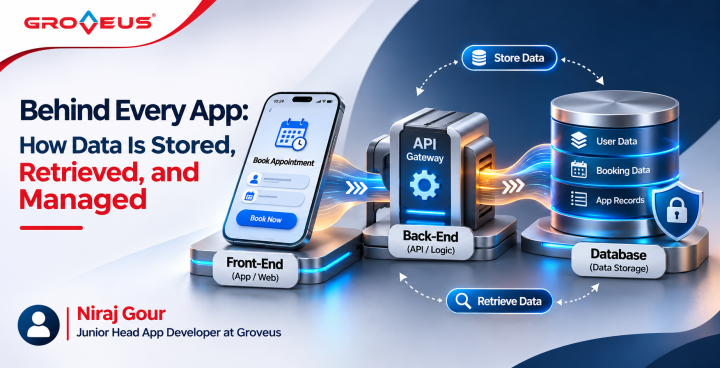
The app itself (on mobile devices or browsers) usually won’t communicate directly with the database. In between the app and database lies a backend. The front-end is the page we view. By clicking a book, the front-end will send a request to the backend (often through an API). The backend will confirm the details, apply rules from the app and tell the database to store the booking.
What happens when you open that booking again?
This process is reversed. When viewing a booking, the app will ask for the data from the backend. The backend will search for this booking within the database and return it. The app will now display information from the booking (date and booking status). Although there are many steps to complete for such a simple task, they can be completed extremely quickly by computers.
Similarly to logging in, updating profiles and adding items to a basket, data is sent from the app. The backend determines what actions must be taken, and data is stored in a database to be possibly used in the future.
Is keeping data in a database enough?
No. Data should be secured. If the app requires users to log in, we wouldn’t want to save the password as plain text. Instead we save a secure hashed version of the password and verify that the password is correct during login. Within the backend, we must also make sure users can only access certain parts of the application. If a customer were to alter the numbers in the URL of the website, we wouldn’t want them to be able to view other peoples bookings.
Much of app development involves ensuring these little processes work smoothly. Although an interface may look simple, data is frequently being passed between the front-end, back-end and database. When working correctly, we generally don’t notice any of these processes. We simply click a button and get what we need.
Comments 0