
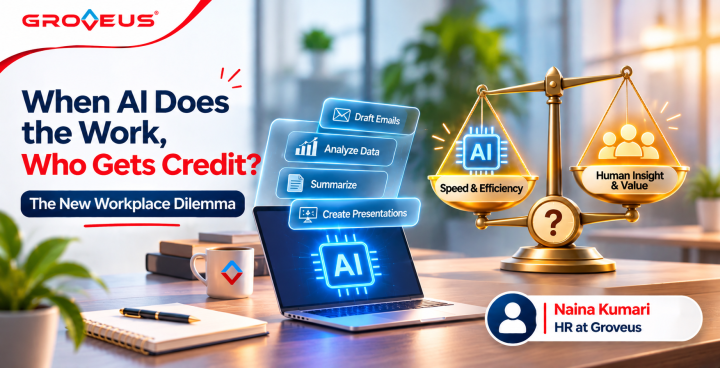
As AI takes on more workplace tasks, discover how businesses can recognise employee contributions, value human creativity and critical thinking, and balance AI-driven productivity with human effort.
The usage of Artificial Intelligence and its influence on day-to-day life of billions of people is out in the open. AI has seamlessly made its place into everyday digital experience making our lives faster. AI is no longer limited to only technology professionals, it is becoming part of everyday office work.
Earlier tasks that would require hours and hours of researching, writing, organising and evaluating can be now done with a single prompt in just a few minutes. Whether it is brainstorming new ideas or putting up a presentation, employees rely on technology to save their time.
But the real question is if AI performs tasks, does that make employees’ contribution less valuable?
For decades, office workflow followed the same pattern. Employees would gather information and would spend hours in preparing the report manually and drafting emails.
With AI, time is changing. Now AI can summarize meetings, draft emails, organize research which overall enables productivity among employees by saving their time. Today AI tools can handle many tasks. With use of AI, tasks that often required more effort and time can now be completed in a fraction of time.
But it doesn’t simply emphasize that human insight is not required. It means the employee doesn’t have to do each step manually. Minor tasks can be managed with AI tools and more time can be provided to tasks that require critical thinking and more time. Efficiency and effort both are two sides of the same coin.
As Artificial Intelligence is becoming a regular part of our workplace, the definition of productivity is also changing. Perhaps productivity should no longer be measured solely by the hours spent completing a task, but by the value and quality of the outcome.
Comments 0