
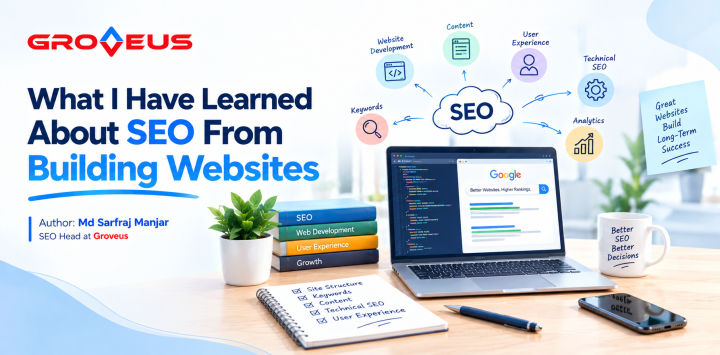
Discover what building websites taught me about SEO, from technical structure and URLs to indexing, page speed, mobile experience and ongoing SEO.
I have learned a lot about SEO while I have been building websites.There is a lot of knowledge I have gained on SEO as I have built websites. I believe that at the beginning of building websites, I only thought about adding keywords to pages and building backlinks. Working on a variety of sites and experiencing actual problems with rank, index, page speed, urls, content and technical problems, I began to understand that SEO is far more related to website development than I had initially thought. The secret to good SEO is to build a technically viable website that serves the needs of visitors, is easy to understand for search engines and is updated regularly.
SEO Starts During Website Development
A quick lesson I have learned is that SEO is not a task that we do after the website is ready, but rather one that you do as you're designing it. Many developers focus on the design and functionality first and think about SEO later. But what can be done during development can greatly affect visibility in the search results. The architecture, headings, internal linking, mobile-friendliness, speed, images, page structure and URL structure of a website should be taken into account right from the start.
Keyword Research Is About Understanding What People Want
One of the other fundamental concepts, which is worth learning from, is the importance of the keyword research. Words are used as keywords to understand what people are looking for. But mere repetition of the same keyword on a page doesn't improve the quality of the page. The search engines now have a better ability to understand user intent and context. I learned that content needs to be natural real and needs to solve the users problem or answer to the users questions. Instead of building a page just because of a keyword with search volume, for example, it's better to understand what information they are looking for once they type in that keyword and create useful content around it.
Website Structure and URLs Matter More Than I Initially Thought
I also learned the importance of website structure content and website URLs while building websites. A clean URL can help make a page easier for users and search engines to understand.
Duplicate URLs Can Create SEO Problems
Too many URLs, extra parameters, duplicate URLs or URLs with inconsistent structure can cause SEO issues. I have done seen cases where several URLs have access to the same content, and this can cause some problems with duplicate-content and/or canonicalization. Correct redirects, canonical URLs, and a consistent URL structure is then crucial in technical SEO.
Having More Pages Does Not Mean More Pages Will Be Indexed
The one thing I have learned a lot is about indexing. Not all of the thousands of pages will be indexed by Google. There are many pages on a website that may be available but offer little value. Search engines must determine which pages should be in their index. This showed me that it's not enough to have a lot of location/service pages. Important pages should not just be replacing the city or keyword around which the page is designed, but having unique, useful and relevant content.
Internal Linking Helps Connect the Whole Website
I also learned about the importance of internal linking, which I didn't initially realize. Internal links assist your visitors to find the content they are looking for and support search engines to recognize the connection between the various pages of your website. An organized website should link important service pages, location pages, blogs, and supporting pages together in an organized way. When adding links, I like to consider how a user would naturally flow from one page to the next.
Website Speed and Performance Affect Both SEO and Users
Another big take away is the issue of page speed and performance. But even if your website is visually appealing, if it doesn't load quickly, then it's not worth it. Images, JavaScript, CSS, unnecessary scripts, and third-party scripts can all impact performance. During the process of building websites, I was able to learn how to optimize images, responsive images, loading of CSS and JavaScript, and even caching. Not only is it beneficial to improve the performance of your website for SEO purposes, it's also beneficial for the user.
Mobile Responsiveness Is Part of the SEO Experience
Another aspect which should not be overlooked is mobile responsiveness. A large number of users are accessing websites from their mobile phones, particularly looking for nearby services. If you have a website that is easy to navigate, has large text and well organized forms on the desktop, but has challenges on mobile, you are losing potential customers. Having learned how to build responsive layouts, I've discovered that SEO and user experience go hand in hand.
Technical SEO Problems Can Affect Website Visibility
I also came to the realisation of the importance of technical SEO factors like title tags, meta descriptions, heading structure, XML sitemaps, robots.txt, canonical tags, structured data, and status codes. All of these are independent but when combined, they aid search engines in crawling and understanding a website. Even a common error like adding an important page to the robots.txt file or specifying the wrong canonical URL can lead to serious visibility issues.
SEO Needs Regular Monitoring After a Website Goes Live
One of the other common mistakes made by people is that they think that SEO is a one-time thing, which is not true. SEO needs to be monitored continuously. Creating a website isn't the end of SEO. Problems that can be hard to identify manually may be identified through Search Console, analytics tools, crawling tools, and performance reports. After updating a website, it may experience changes and become unavailable, or the URLs may change, with indexing dropping or technical errors occurring. It's important to regularly check on them to catch the problems before they turn into bigger ones.
SEO Is Not About Tricking Search Engines
Last but not least, after creating websites, I've learned that SEO is not about “tricking” search engines. The main aim of SEO is to create a useful website for real people and in that regard, sustainable SEO is just that. These all play a part – good content, clean technical implementation, fast performance, helpful navigation, relevant keywords and a great user experience. When developers and SEO professionals work together, they can use their collaboration to improve results, as opposed to SEO being tacked onto the end of the development process.
The main thing I learnt was that each development decision can affect the SEO. The organization of pages, how they are interconnected, their presentation, and loading speed can all impact the ease with which users and search engines can interact with the website. The way that I think about SEO has therefore evolved with the building of websites. Now I don't see SEO as only keywords and backlinks; I see it as a technology, content, user experience and continuous improvement.
Comments 0