

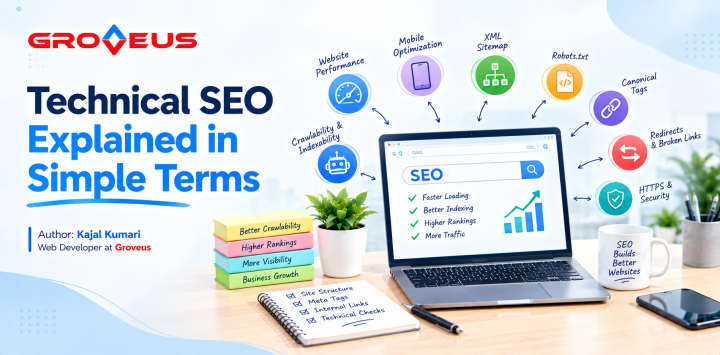
Learn technical SEO in simple terms, including crawlability, indexing, website speed, mobile optimization, sitemaps, robots.txt, redirects and canonical tags.
With the term SEO, the first thing that typically springs to mind are keywords, content, backlinks and rankings. However, there is another important factor in SEO that is known as "Technical SEO.
Having fantastic content and a great website, but failing to be found and understood by a search engine, you are going to have difficulties. This can affect users and search engines if your website is slow to load, has broken links, is not mobile friendly or has problems with how it is indexed. It is therefore essential to have a good technical foundation for the optimized website, which should also perform well with search engines.
What is Technical SEO?
Technical SEO includes the optimization of the technical aspects of a webpage that helps search engines crawl and index the website, along with interpreting its content.
This includes how well the site is structured, how quickly the pages load, how the site performs on mobile devices, XML sitemaps, robots.txt, redirects, canonical tags as well as website indexing and website security.
It's not only about creating material; it's about making certain that the web pages that are already out there can be effortlessly discovered and comprehended by search engines.
Why is technical SEO important?
Crawlers are used to search engines discover and process websites' pages. If there are any technical problems, some of the pages could not be found or indexed as planned.
An example exists where one of the pages of a site has been helpful and has an appropriate service page on the same page, yet even it is blocked unintentionally when using the `robots.txt` file, or by a `noindex` tag in the page itself, the page may not display as is expected.
SEO optimization is much more technical compared to SEO optimisation, which helps the search engine crawlers find it easier, and also helps the visitors to use the site easily and conveniently.
Let's dive into some of the essential aspects of technical seo.
1. Website Performance
Websites need to be fast due to the fact that all users tend to wait for a short amount of time for the websites to load. A website can be slow due to large images, unnecessary JavaSource scripts and under optimization of resources.
Performance can be enhanced with the compression of images, the elimination of unused resources, utilization of caching and optimized server response time.
2. Mobile Optimization
The website should be user-friendly when accessed from a mobile platform or device and from a Desktop PC with the desktop browser and a tablet PC with the standard Safari browser. Great mobile experience is achieved by these: responsive design, readable text, easy to navigate and appropriately sized buttons.
3. Crawlability and Indexability
Crawlability is how well search engine bots can reach the pages of a website. Indexability is the term that is used to describe whether the pages can "be processed and added to a search engine's index".
Several things inside the website can impact how the website is crawled and indexed, including the internal linking structure, structure, `robots.txt`, and meta robots directives.
4. XML Sitemap
A site map is a file that includes a list of URLs of significance on a website. It helps search engines find pages especially on websites with a large amount of pages or websites which add more data on a regular basis.
You may not have a sitemap but this can assist search engines find the important pages.
5. Robots.txt
A robots.txt file is a web page that instructs search engine bots on which parts of your page(s) to crawl.
It will need to be installed with extreme care. Confusing pages you would not want to be confused by accidentally blocking important pages can mean that the search engine can't reach the pages with the content you want into the search results.
6. Canonical Tags
The same/or identical content can be available in different urls. To strip some of the query parameters off and mainly represent the element that matters, it is used in long URLs containing many different query parameters.If you have a long URL (with a lot of query parameters), and you want, say, a search engine to present a different version of that URL instead, they can be very helpful.
This is highly advantageous in the event you have a variety of URLs or a variety of webpage parameters.
7. Redirects and Broken Links.
Websites are a dynamic environment. Pages may be deleted, renamed and moved to a new URL. Use the appropriate redirects to make the user and search engine take them to the correct new page linked with the old page, e.g. by using the 301 redirect.
Ensure that checks on broken links and unnecessary redirects are conducted from time to time so that the structure of the website is kept clean.
8. HTTPS and Security
HTTPS is one of the methods that a website can use to connect with their visitors securely. Ensures data security when sending and receiving, allows for secure browsing by the user.
Whether you are running a healthy and safe web site or a modern website one of the essentials of keeping them healthy and safe is implementing HTTPS.
Final Thoughts
Your whole SEO strategy depends on Technical SEO. It assists search engines to crawl your website, and make it a better visitor experience.
It's not the kind of thing that you set up and never come back to. Websites are also really dynamic, with new pages added, outdated pages eliminated and technical modifications thrown in. Problems can be averted by regular checks to detect symptoms, and to find them early.
Good content makes the search engines realise what your website is about and technical SEO assures they will discover and interpret your content properly.
Comments 0