

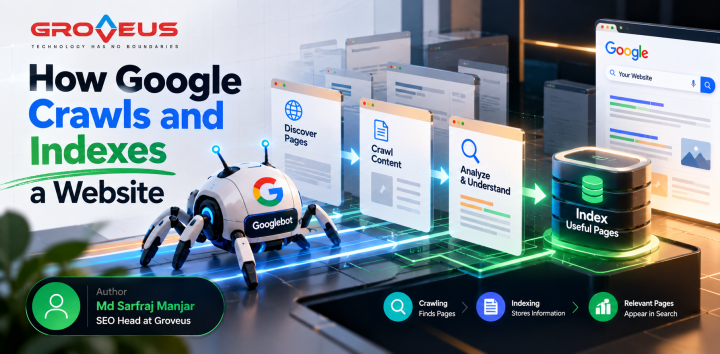
Learn how Google crawls and indexes websites, how Googlebot discovers and analyzes pages, and how SEO, sitemaps, internal links, and technical health support search visibility.
Have you ever thought of how your website gets on Google when you do something related to your website? As far as users are concerned, it is pretty straightforward, but behind all this lies a lot of effort. If you want to show your webpage on Google search engine results, Google have to find out about this page, analyze it, and understand why should be included in the search index or not.
What Is Google Crawling?
Crawling is the process that Google uses in order to discover pages which are available online. Google uses special automated programs called Googlebot which visit webpages and go from one page to another through links.
Hence, if Google already knows about your main webpage and sees a link to your services webpage of your website, it is possible that Googlebot will follow this link and discover this new page. Google can discover webpages using XML sitemaps as well as other methods.
However, the mere fact that Google can discover a URL does not mean that it will start crawling this webpage immediately. Big websites, websites that have any technical issues, or websites with a lot of worthless pages can be crawled only after some time.
This is the reason why it is important to have a clean website structure, good internal links, and XML sitemap updated.
What Happens When Indexing Webpages?
When Google finds a webpage, then it tries to understand its purpose. Google analyzes everything from page content, titles, headings, images, links, structured data, and other elements of a website.
If Google finds that the webpage is useful to be indexed on google, then a copy of this webpage is stored by Google in its search index. The search index can be considered as a huge database containing information about all webpages Google has found during its crawlings.
However, being indexed is not guaranteed.
Sometimes Google crawls a webpage but does not include it in the index. There can be a lot of reasons for this situation, including duplication of content, low-quality content, technical issues, wrong canonical tags, and others.
Why Does Google Choose Certain Pages for Display?
Once Google has indexed a page, Google starts considering it when someone does a search query. At this step, ranking algorithms use a lot of factors in order to define which pages are more useful for a person who is looking for some information.
At this step SEO plays an Important role. Useful content, relevant keywords, good internal links, mobile-friendliness, performance of the website, and technical health of the website are very important here.
One needs to keep in mind that indexing does not mean ranking. Sometimes, even when the webpage has been indexed, it can have a very bad position among other search results.
How Can You Help Google Discover and Analyze Your Pages?
There are some simple actions that website owners and developers can perform:
Create a clean and clear website structure.
Have title and descriptive and SEO-friendly URLs.
Build internal links to websites.
Submit XML sitemap by Google Search Console.
Never block important pages in robots.txt.
Use canonical tags properly in the header.
Fix broken links and unnecessary redirects.
Make sure that important content can be accessible for search engines.
Have a good performance and mobile-friendliness of the website.
Conclusion
Google crawling and indexing are the basics of organic search visibility for your website. If Google cannot find and analyze your pages, then even the best content will fail to rank your site.
In this connection, SEO should not be considered as something that can be done after website development. Developers and SEO professionals should cooperate from the very beginning of creating a website in order to build a website that will be easily accessible both for users and search engines.
Comments 0