

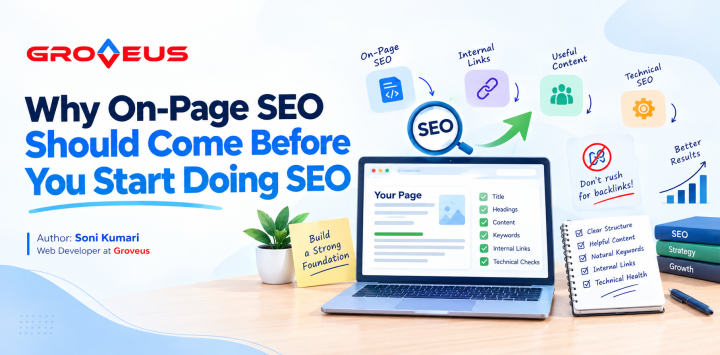
Learn why On-Page SEO should come first, from page structure and keywords to internal links, useful content and technical checks.
You have launched your website. The pages are live. Your services are listed. The contact form works. Now comes the obvious question: how do you get more people to find it on Google?
A lot of businesses immediately start looking outside the website.
They think about backlinks, business listings, social media promotion and other off-page SEO activities.
Those things can have their place. But there is something I would check first: the website itself.
Before trying to send more people to a page, make sure the page is actually ready for them. That's where On-Page SEO becomes important.
It helps organize information on a webpage so that visitors can understand it easily and also it gives search engines clearer signals about what the page is about.
Look at the Page Before Looking for Backlinks
Imagine you've opened a shop. You wouldn't invite 100 of customers inside before checking if the shelves are organized, the products are labelled and people can find what they're looking for.
A website works in a similar way. Before starting other SEO activities, go through the important pages on your website. Check the page title, headings, URL, written content, images and internal links.
Then do something simple. Read the page as if you've never seen the business before. Can you understand what the company offers within a few seconds? Is the main service obvious? Are the important questions answered?
Let's say you have a page targeting Packers and Movers in Siliguri. The subject should be clear without forcing the exact keyword into every other sentence.
The title should make sense. The headings should support the topic. The content should explain the service properly.
That's a much healthier approach than writing a page simply to repeat a search phrase.
A Good SEO Page Still Needs to Help People
This part is easy to forget. SEO can bring someone to your website but it doesn't automatically convince them to stay.
A visitor comes because they want something. Maybe they're looking for a moving company. Maybe they want to understand a service. Maybe they're comparing different options before contacting a business.
The page needs to help them make sense of that information. For a moving service page, a visitor might want to know:
What services are available?
Which locations are covered?
How does the process work?
What does the service involve?
What should I do next?
If the page doesn't answer those basic questions, getting someone to visit it isn't enough. They will go back to Google and choose another result.
That's why I see On-Page SEO as more than an optimisation exercise. It's also about making the page useful.
Stop Counting Keywords and Start Answering Questions
There's a common way of thinking about SEO that goes something like this: "How many times should I put my keyword on this page?"
I prefer a different question: What would someone searching for this topic actually want to know?
Take car transport services as an example. You don't need to repeat "car transport services" in every paragraph.
You can explain how vehicle pickup works, how transportation is handled, what happens during delivery, how vehicles are protected and which locations the company serves.
The topic becomes clear naturally. Related words and phrases will appear as part of the explanation because you're actually discussing the subject.
Good content doesn't need to sound like it is trying to prove that it knows the keyword. It just needs to answer the searcher's need.
Internal Links Give Your Website a Structure
Think of internal links as paths between related pages. Suppose your website has a page about house shifting. Somewhere on that page, you explain that customers can also get professional packing support.
If you have a dedicated packing service page, linking to it makes sense. The visitor doesn't have to return to Google and search for the service again. They can continue exploring your website.
Internal links can also help search engines discover other pages and understand the relationship between different pieces of content.
But don't add links just because you have a linking target. A link should have a reason to exist. If it helps the reader, it probably belongs there.
Don't Forget the Basic Technical Checks
On-Page SEO isn't limited to written content. Before considering a page ready, check the basics.
Does the URL open correctly?
Do the important links work?
Can visitors access the important information without unnecessary barriers?
Do the images load properly?
Does the page work comfortably on a mobile phone?
These aren't glamorous SEO tasks. Nobody gets excited about checking a broken URL. Still, they're worth doing. A beautifully written page isn't much help if the visitor can't use it properly.
So, Should You Build Backlinks First?
This is where the order of work matters. Off-page SEO can help increase a website's visibility and authority. But eventually, people still land on your website.
That's the moment that matters. If they arrive at a page with unclear information, weak structure or missing answers, additional promotion won't solve that problem.
You might get more visitors. You won't necessarily get a better page.
So before spending time trying to bring more attention to a particular URL, take a step back and examine what's already there.
Is the page focused on one clear subject?
Does the heading structure make sense?
Does the content answer real questions?
Are relevant pages connected?
Does the page work properly across devices?
If the answer is yes, you've got a much better foundation to build on.
A Simple On-Page SEO Check Before You Move Ahead
Before starting your next SEO campaign, take a few minutes and review your important pages.
Check the title. Does it clearly describe the page?
Check the headings. Can someone scan them and understand the page?
Check the content. Does it actually answer the questions a visitor may have?
Check the keywords. Are they used naturally rather than repeated?
Check internal links. Do related pages connect where useful?
Check the technical basics. Are the URLs, images, links and mobile experience working properly?
You don't need to make the page complicated. In fact, the opposite is more useful. Make it clear. Make it useful. Make it easy to navigate.
Start With the Foundation
SEO isn't only about what happens outside your website. The page itself matters.
Before building backlinks, creating listings or investing heavily in promotion, take a proper look at the pages you're sending people to.
A clear page gives visitors a reason to continue reading. A useful structure makes information easier to find. Natural keyword usage helps communicate the subject without making the writing awkward. Internal links help connect related information.
None of this guarantees rankings. But it gives your SEO work a sensible foundation. And that's really the point.
Don't rush to promote a page before you've made sure the page deserves the attention. Good SEO starts with a website that people can actually understand and use.
Comments 0