

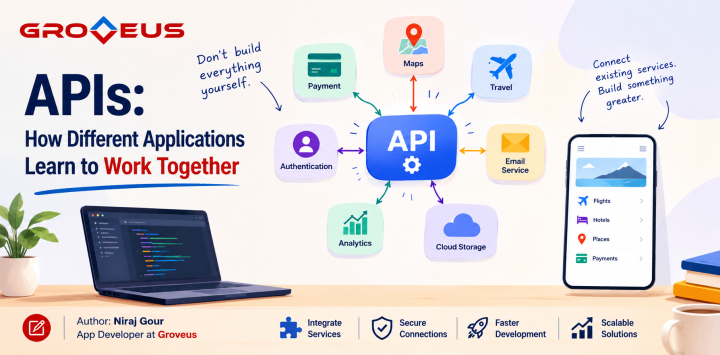
Learn how APIs connect applications, share data and services, support business systems, and make modern software easier to build and integrate.
APIs: How Different Applications Learn to Work Together
Most applications are not built to do everything on their own. Think about a travel app. A user may open one application to check flights, compare hotels, look at a map, make a payment. It looks like one smooth experience from outside but several different systems are working behind the scenes to make it happen.
This is where APIs come in. An API, short for Application Programming Interface, gives different software systems a defined way to communicate. One application can ask another system for information or request a particular function without needing to know what is happening inside that system.
Why Do Applications Need APIs?
Building software from scratch sounds straightforward until you look at everything an application actually needs.
Take online payments as an example. A business could try to develop its own payment infrastructure, but that means dealing with a large number of technical and operational requirements. The same applies to maps, messaging, travel information and many other services.
If a reliable service already exists, there can be little reason to build another one from the beginning. An API allows an application to connect with that existing service and use its required capability.
This saves development effort and lets your team spend more time working on the part of the product that matters to its users.
One Application Can Use Many Different Services
A travel application is a simple way to understand this.
The application itself is responsible for showing the user a clean interface and helping them search for a trip. But the information displayed on that screen could come from several different systems.
For instance, it may connect to:
a flight service for schedules and availability
a hotel service for accommodation information
a mapping service for locations and directions
a payment service for completing the booking
The user does not necessarily see these separate connections. They simply see one application doing several jobs. APIs make that possible.
APIs Also Help Businesses Avoid Building Everything Internally
There is another side to this. For many businesses, software development resources are limited. Developers have to decide where their time will create the most value.
If a company's main product is not a payment platform, spending months creating an entire payment system may not make much business sense. It may be more practical to connect with a specialised payment provider instead.
The same thinking can apply to maps, communication tools, travel databases and other services.
The company can use existing capabilities where appropriate and put more attention into the features that make its own product useful or different.
That does not mean the business becomes dependent on someone else for everything. It simply means it does not have to reinvent every part of the technology stack.
APIs Can Connect Systems Inside a Business Too
APIs are not only about connecting one company's application with an outside service.
Large organisations often have several internal systems running at the same time. Customer information may be stored in one system, inventory in another, payments somewhere else and reporting in another place.
These systems still need to exchange information.
Suppose a customer places an order. The order system may need to communicate with inventory, payment and customer management systems. If these systems can communicate through APIs, information can move between them without requiring the entire organisation to run on one single application.
This becomes increasingly useful as a business grows.
A company can introduce a new application without necessarily throwing away every system it already has. Where suitable connections are available, the new application can work with existing technology.
The Benefits Come With Some Responsibilities
APIs make software integration easier but they are not completely risk-free.
The moment an application relies on an external API, that service becomes a dependency.
If the external service goes down, application using it may also be affected. An API provider could change its technical requirements, introduce usage limits or alter its pricing. Even a small change can sometimes create problems for applications that depend heavily on that connection.
Developers therefore have to think beyond simply making the connection work.
They need to consider things such as:
Reliability
What happens if the API is temporarily unavailable?Security
How will information and access credentials be protected?Authentication
How will the system confirm that a request is authorised?Error handling
What should the application do when a request fails?Usage limits
How many requests can be made within a given period?Changes
What happens when the API provider updates its service?
These considerations are part of building a dependable application.
APIs Change the Way Software Is Built
The bigger idea behind APIs is not just about saving developers some coding time. They encourage a different way of thinking about software.
Instead of asking, "Do we need to build this ourselves?", a development team can ask, "Does this capability already exist, and can we connect to it?"
That question can change the scope of a project greatly.
A team may be able to combine its own technology with specialised services from other providers and create something useful without developing every individual component internally.
Software Can Work Together Without Becoming the Same Thing
This is the simplest way to understand APIs, probably.
Two systems do not need to be built by the same company. They do not need to use same technology internally. They do not even need to know how other system works behind the scenes. They only need an agreed way to communicate.
One system provides a capability. Another system requests it. Information or a response is exchanged, and the application continues with its work.
That simple idea sits behind a large part of today's connected software environment.
APIs have therefore become an important part of modern software development because they allow businesses to combine different capabilities without building every piece from the ground up.
Good software is not always about building more. Sometimes, it is about knowing what is worth building yourself and what is better connected through an existing service.
Comments 0