

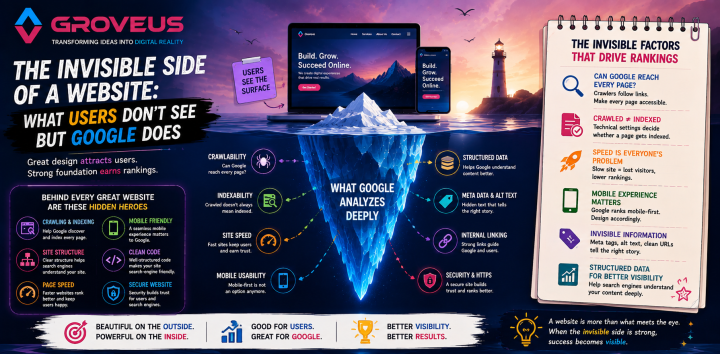
Explore the hidden side of websites and learn how technical SEO, crawlability, indexing, speed, mobile usability, and site structure influence Google visibility.
The Invisible Side of a Website (What Users Don’t See but Google Does)
Have you ever entered a website and thought, “Wow, this looks amazing”?
Usually, people make up their mind whether they like a website during those first couple of seconds after entering it. We look at its design, images, colors, menu, and content. If the website is easy to use and everything opens without any problem, we simply continue browsing. We don't really stop to think about what is happening behind the page.
But there is a whole different side of a website that most visitors never notice.
Every button, page, image, and link has something working behind it. There is code running in the background, a proper structure connecting different pages, and technical information that helps search engines understand the website.
A visitor may never see these things, but Google does.
And sometimes, these hidden elements can make a bigger difference than the design we see on the screen.
What You See Is Only One Part of a Website
We usually judge a website by what we can see. If the design is good and the pages work properly, we don't give much thought to anything else. But there is a lot happening behind every webpage. Code, links and different technical settings all work together in the background. Google looks at these parts while understanding a website, even though a normal visitor never notices them.
But then someone searches for those services on Google and cannot find the website anywhere.
Often, the impression would be that the website requires more content or better keyword coverage. Of course, this assumption may be correct, but sometimes there are more significant problems that are hidden behind this superficial layer.
Sometimes, Google is unable to crawl some pages correctly. Maybe important pages are not indexed. Perhaps some links are broken, the website loads slowly, or a technical setting is preventing search engines from accessing certain content.
A normal visitor may never notice any of this.
They can open the website, read the content, and leave without knowing that there is a technical issue in the background.
This is why creating a website is not only about making it look good. The things happening behind the screen also have a role in how well a website performs online.
Important links may be missing. Some pages may not be indexed. Images might be too large and slow down the website. There could even be technical settings preventing search engines from accessing certain content.
None of these problems are obvious when you simply look at the website.
That is why a website needs more than a good design.
Google Looks at the Structure Behind the Page
When a person visits a webpage, they can look at the whole page and understand it naturally. Google has to process the information in a different way.
The structure of the page gives search engines useful clues.
HTML is an essential aspect of the website structure. Headings, paragraphs, links, images, lists and many other structural elements are used to organize the website content.
Imagine that you enter a service page and see there one heading and several subheadings explaining the service, its advantages, process, prices or frequently asked questions.
It makes sense to say that proper structuring makes the page not only readable by users but also more understandable for search engines.
Good coding is therefore not only about making a website work. It can also help make the website easier to understand.
Can Google Reach Every Page?
This is something website owners sometimes overlook.
A website may have many useful pages, but Google first needs to discover them.
Search engines use crawlers to explore websites. They move from one page to another by following links and looking at the information available on those pages.
This is where internal linking becomes useful.
For example, if a company has a page about “Web Development Services,” it should be connected naturally with relevant pages on the website. If an important page has no useful links pointing toward it, discovering that page can become more difficult.
Broken links can create another problem. A visitor may see a broken link and simply go back. For a website owner, however, repeated broken links can be a sign that the site's structure needs some attention.
A website should not just have pages. Those pages should also be connected properly.
Being Crawled Does Not Always Mean Being Indexed
Indexing is one of the steps that usually causes confusion.
Just because Google has discovered a page, this does not always mean that the page will be indexed.
Crawling and indexing are two different processes.
Technical settings influence the way search engines will interact with the page. Robots.txt, meta robots instructions, canonical tags, redirects and other aspects are very important depending on the website.
This is one of the reasons why technical SEO is tightly related to web development.
A page may look completely normal to a visitor while having an issue that affects how a search engine processes it.
Website Speed Is a User Problem Too
A website that takes too long to load is not what people like.
When someone clicks on the page and waits while the website opens, the most likely scenario is that this person will simply leave the page without reading even one line. And this situation becomes even more obvious if the person uses a mobile device or has a slow Internet connection.
There are many aspects that can make the website slow. For example, big images, unnecessary scripts, unoptimized code, excessive number of resources and slow server response time are some of the most typical examples.
The interesting thing is that visitors usually do not know what caused the problem.
They simply think, “This website is slow.”
At the same time, developers can go deeper and find the source of the problem. Image optimization, cache optimization, code optimization and other technical changes will help with solving the problem.
Mobile Users Should Not Be an Afterthought
A website may look excellent on a desktop computer but completely different on a phone.
Text may be difficult to read. Buttons can be too close together. A form may not fit properly. Images might extend beyond the screen. Even the navigation menu can become difficult to use.
Of course, these aspects cannot be neglected when the website has many visitors using smartphones.
Responsive design allows adjusting a website layout for different screen sizes. At the same time, good mobile design is not only about making everything smaller. The entire website should be comfortable to use in a mobile environment.
A visitor should be able to read, click, scroll, search, and submit a form without struggling.
There Is Information on a Page That Visitors Never Notice
Title tags and meta descriptions are good examples.
To get the idea of a page is about what, here the title helps. And the description or the short summary is the meta description.
A person can look at an image and get the idea of what it is. To understand the meaning of the picture correctly, search engines should know additional information. This can be provided with alt text and increase accessibility of the website as well.
The Technical Side of URLs
URLs are another important part of a website that we mostly ignore considering it less important.
A URL which is clean helps to understand what the page consists of. The URL with the name of the service is more informative than a random set of characters and numbers.
In case of large websites, there are often several URLs referring to the same content. In such cases, canonical tags will help to show which version of the page should be preferred.
Again, this is something most visitors will never think about, Google does.
Structured Data Provides Search Engines Deeper Context
Sometimes, webpages contain information that can be useful with additional context.
Providing opportunity to website owners to give the needed information in a special format that is easy to understand by search engines - that is the essence of the structured data. Visitors to the website should be able to read, click, scroll down, search for something and submit a form without any difficulties.
Structured data is not a shortcut to the first position on Google, it never guarantees higher rankings. Rather it helps search engines understand what a webpage represents in the form of information.
Why Developers and SEO Teams Should Work Together
One thing becomes clear when we look at all these technical elements: SEO and development cannot always work separately.
SEO professionals may notice that a page is not being indexed properly. Only then developers may check the code and other technical settings just to solve the actual issue with the code.
On the other hand, developers create websites which work perfectly from technical angles, when SEO professionals identify any issues with that specific page structure, metadata, internal links, search visibility and other small yet impactful technical points.
The Website You See Is Only the Surface
A website is much more than its homepage.
Behind the design are hundreds of small technical decisions. How the pages are connected, how quickly resources load, how the HTML is structured, whether Google can crawl the pages, how mobile users experience the site, and how information is presented to search engines- all of these things matter.
Visitors may never see this side of the website.
Google does.
And that is exactly why the invisible part deserves attention.
A website should not just be made to look good. It should be easy for visitors to use as well. Pages need to load properly, important information should not be difficult to find, and the site should make sense to search engines too.
A good-looking design can definitely catch someone's eye, but looks are only one part of a website.
The content and the technical work behind the website also matter. When all these things are taken care of, the website has a better chance of doing well online.
Comments 0