

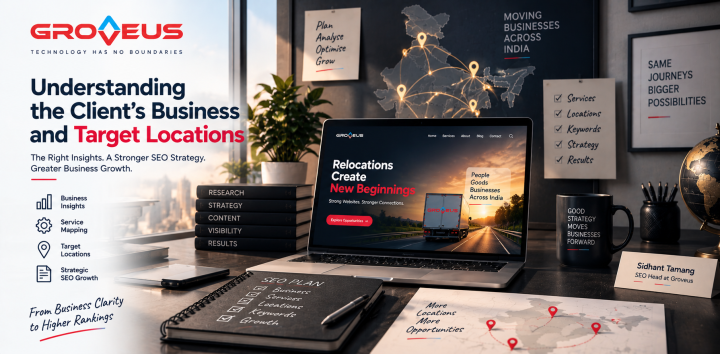
Learn how understanding a client's business, services, target locations, and search intent can shape a focused SEO strategy and stronger website structure.
SEO does not start with a keyword list. It starts with getting to know the business behind the website. While before starting SEO optimization you would already choose the keywords, define the required pages and the locations you need to optimize for, it is crucial to have an idea about what the business actually does, where it provides its services and what kind of searches can bring the right visitors. If you do not have this knowledge, even the best planned SEO strategy can be moved in the wrong direction.
The business can provide various services, but each of them is not equally demanded and valuable. Some may be the main source of enquiries, while others may support a smaller section of the business. The first step is therefore to map the complete service structure. For example, a logistics website may have local shifting, domestic relocation, vehicle transportation, storage and office relocation under the same brand. Each service has its own search terms, user intent and competition. Understanding these differences helps create a more practical keyword strategy instead of treating the entire website around one broad term.
Location Research Changes the SEO Strategy
Location is another point that requires special care, especially when it comes to businesses offering their services in several cities. Sometimes the business can be located in one city while providing services in others or even in several states. Then it is not enough just to add city names to the already existing keywords. The SEO strategy should be developed considering where the business operates, what locations are commercially significant and how people search for this service there.
Local search behaviour can vary from one place to another. Users may search using a city name, neighbourhood, nearby landmark, service area or phrases such as “near me”. Search results can also differ based on location. This makes location research an important part of keyword mapping and landing-page planning.
For a business serving multiple locations, each target area should have a clear purpose. Important locations may require dedicated landing pages, while smaller service areas can be handled through a broader regional structure. The goal is to create useful location signals without producing dozens of nearly identical pages with only the city name changed.
Business Knowledge Improves Keyword Selection
Once the services and target locations are clear, keyword research becomes much more meaningful. Instead of selecting keywords only because they have search volume, SEO analysis can consider their connection with actual services and customer intent. A keyword should have a clear relationship with what the business offers and the location it serves.
Competitor analysis becomes more useful at this stage as well. Looking at competing websites can reveal which services they target, how their location pages are structured, which keywords appear repeatedly and where gaps may exist. However, competitor structures should be studied for insights rather than copied directly.
The same understanding also helps with website architecture. Service pages, location pages, supporting pages and internal links should have a logical relationship. Search engines should be able to discover important URLs easily and understand what each page represents.
SEO Begins With Business Understanding
Technical optimization, keyword research and link building are all important aspects of SEO, but all of them should be planned taking into account the understanding of the client's business.
The process becomes much stronger when it follows a simple sequence:
Business –> Services –> Locations –> Search Intent –> Keywords –> Website Structure –> Optimisation –> Measurement
In this way, SEO stays related to the business and not the list of keywords.
The better you know the business from the very beginning, the more accurate your SEO strategy can be later.
Comments 0