

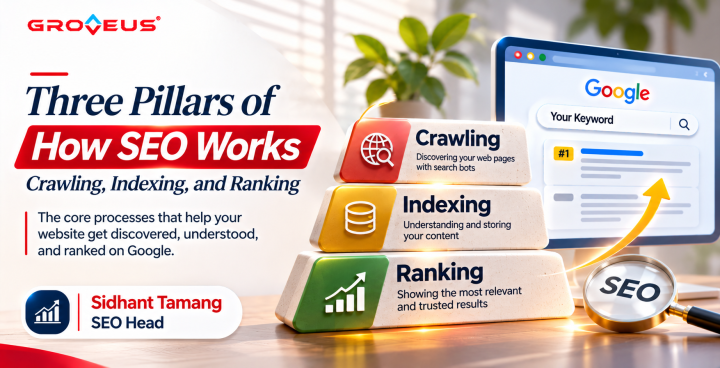
How SEO works through crawling, indexing and ranking. Learn how search engines discover web pages, understand website content and rank relevant results, along with practical tips to improve your website’s search visibility.
Crawling, Indexing and Ranking is the main three pillars of SEO to show ranking in google search. When you type a question or keywords in google search bar and hit enter, many web pages are sorted in a second to give the most relevant answers. Though Search Engine Optimization (SEO) may seem like a complicated network of keywords, backlinks, and algorithm changes, the three most essential processes that a search engine performs are crawling, indexing, and ranking.
In order for your site to be found, understood and recommended by search engines, you need to understand these three pillars.
1. Crawling: A search engine needs to be aware that your pages exist before it can display your website to users. The discovery phase is crawling. Crawling is the discovery phase. Search engines use automated programs called bots, spiders, or crawlers (such as Googlebot) to discover new and updated content on the Internet.
To optimize for crawling:
Keep the site structure clean, logical and have good internal linking as bots will get stuck if it is not.
Use a site map in XML format to submit to sites such as Google Search Console to provide a directory of important URLs.
Check your robots.txt file for any issues that may be preventing crawlers from accessing important parts of your website.
2. Indexing: If a page is found by a crawler, the search engine will attempt to determine what the page is about. This is known as indexing. Imagine the index as a large, digital library catalogue listing all of the web pages that have been discovered.
The best way to optimize for indexing:
Prevent duplicate content which is confusing the search engines on which version of a page to store.
Include descriptive and clear title tags, meta descriptions, and header tags (H1, H2, H3) that indicate the main topic of your page.
Make sure that your pages are accessible without server problems (5xx) or broken links (404s) that could interfere with the indexing process.
3. Ranking: The last stage, and the one that the user actually sees. The search engine finds the most relevant, trustworthy pages and orders them most to least relevant when someone does a search.
How to optimize for ranking:
Do your research and write comprehensive, original content that truly addresses the question.
Optimize technical performance (Core Web Vitals, mobile responsiveness), to provide a smooth user experience.
Earn authoritative backlinks from authoritative and industry-relevant sites.
Coming together, building the Pillars
SEO doesn't involve manipulating an algorithm, it's about eliminating friction from the search engine's process. When bots are unable to access your page, your pages won't be indexed. If your pages aren't properly indexed, they will never rank. When you integrate your technical infrastructure and content planning around these three bases, your website will be in a position to attract steady, long-term organic visitors.
Comments 0