

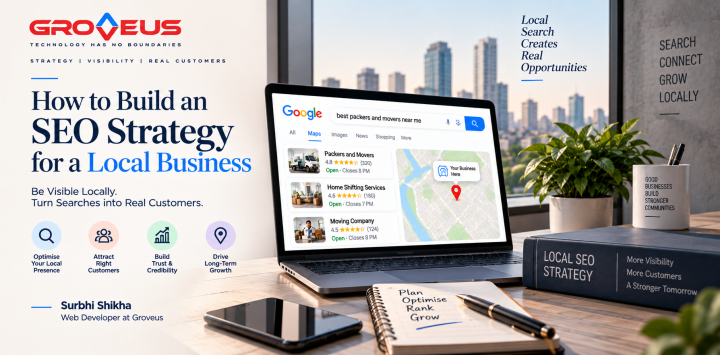
Learn how to build a strong Local SEO strategy using Google Business Profile, local keywords, reviews, location pages, technical SEO, and relevant local backlinks.
How to Build an SEO Strategy for a Local Business
Customers who require services like house shifting, moving companies or packers and movers services, travel services or local catering services aren't solely depending on billboards or the traditional telephone directories. Rather, they resort to Google to look up local service providers that are trusted in their vicinity.
This is where Local SEO plays an important role. Local SEO can help your business pop up in front of customers who are searching for the services you provide in their nearby area.
A custom designed Local SEO strategy can help fill the void. Instead of targeting customers across the country local SEO targets customers in your service areas who are looking for high-intent customers.
How to enhance your local search ranking and get more customers, step-by-step approaches are as follows:
Improving your Google Business Profile (GBP) is very important
Google Business Profile (GBP) is a very important part of local search visibility. It can boost the visibility of your business on Google Maps and local search and even the Local 3-Pack.
Claim and verify your profile : Ensure that your business profile is claimed and verified following Google's verification process.
Employ your actual business name : Do not use unnecessary keywords in your business name. For instance, take out the words "Best Cheap Roofer" and use "Ace Roofing" instead of "Ace Roofing Best Cheap Roofer. You should avoid using too many of these keywords, and if you do, this is known as ‘stuffing’, which may be against the guidelines and could lead to problems with your profile or even suspension from the site.
Choose the appropriate primary category : Understand which category is most accurately describing your primary business service. You could choose, for instance, an HVAC Contractor instead of a Contractor if applicable.
Maintain a profile : Add good pictures of your team, site, services, and projects completed on a regular basis. It's also possible to post business news, updates, or promotions.
Build a Community of Interest to monitor and maintain your NAP
Important key trust signals for search engines is consistent business information. Make sure your NAP (Name Address and Phone Number) is correct and matches in all online directories and on your website.
Review current listings : On review Yelp, Apple Maps, Bing Places, Yellow Pages, local directories and Chamber of Commerce websites.
Consistency in formatting : Ensure your business address is the same on all platforms. For instance, if your site is called Suite 200 on your site, then avoid changing it to Site 200 or "#200" on other listing sites.
Use a suitable business telephone number: Use a telephone number that is connected to your business location, and have the same number listed everywhere online.
Target Geo-Modified and Intent-Driven Keywords
Using a wide range of keywords might bring visitors to your website who may not buy anything. If you offer services in a particular area, you can use local keyword targeting to reach those who are searching for your services in that area.
Apply a local keyword formula: Localize your main service with a city, neighborhood or area:
For instance: "Commercial HVAC Repair in West Bengal".
Establish individual service pages : Don't have all your services on one page; have well-rounded pages for every significant service you offer.
Develop location-specific landing pages : If your business is located in multiple cities, suburbs or neighborhoods, you could develop useful, unique landing pages for each location. Provide local information as applicable, customer reviews, service information, case studies and directions as they apply. Don't duplicate content on several location pages.
Optimize On-Page Content and Technical Structure
Your website should convey clear and consistent messages regarding businesses, services and services locations.
Optimize title and H1 headings: Naturally use the main service and location.
Implement LocalBusiness Schema : Add relevant LocalBusiness structured data using JSON-LD where appropriate. This can assist search engines with information like your business name, address, phone number, hours of operation and other appropriate business information.
Embed a Google Map : You might consider putting a Google Map in your Contact or Location page to help customers locate your business.
Optimize for mobile : Optimize for mobile, as many local searches happen on mobile devices. Improve page speed, Core Web Vitals, mobile usability and CT-to-call to offer a better user experience.
Develop a Regular Customer Review Plan
Customer reviews can have an impact on both local search visibility and customer trust. A steady and authentic review generation process can assist show that your business is alive and serving customers.
Request post-service feedback : Have a procedure in place to ask customers for feedback after jobs or sales are completed.
Make it easy for customers to review: Send a direct Google review link via SMS, email or other channel.
Answer reviews : Answer positively and negatively, professionally. Thank consumers for positive feedback and respond positively to negative feedback. If applicable, ask customers to reach out to your company to address specific problems.
Link with Relevant Local Businesses and Get Mentions
While high-authority backlinks back up your broader SEO efforts, locally relevant links and mentions can help build a sense of community or service area around your business.
Help local events : Sponsor local events, youth sports teams charity events or local initiatives that have a legitimate need for online mentions or links.
Collaborate with complementary businesses: Partner with other local businesses that don't compete for resources on helpful guides, resources, events, or cross-promotion.
Reach out to the local media : Share helpful information with local journalists and media outlets as appropriate. Feeding the information to experts can help secure a mention and a citation.
Join appropriate local groups : Local business associations, chambers of commerce, and industry organizations that are appropriate for your business and community.
Conclusion
A successful Local SEO strategy is more than simply adding a city name to your website. It includes optimizing your Google Business Profile, ensuring consistent business information targeting local keywords, optimizing your website's technical structure, building authentic customer reviews and generating local and relevant mentions and backlinks.
Focusing on these aspects consistently can help businesses enhance their local search visibility, ensuring customers easily find their services and improve the overall search user experience when looking for nearby answers.
Comments 0