

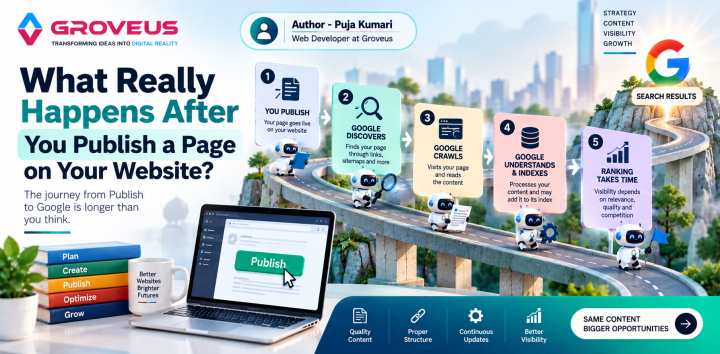
What happens after you publish a webpage? Discover how Google finds, crawls, understands, indexes, and ranks your page, and why publishing is only the beginning of SEO.
You have written the content, checked everything and clicked the publish button. The page is now live. But when you search for it on Google,you cannot find it. So, what happened? Did Google miss your page? Is something wrong with the website? Not necessarily.
Publishing a page and seeing it on Google are two different things. A page goes through a process before it can become visible in search results, and understanding this process can help website owners know what to expect.
It Starts With Discovery
For a page to appear on Google, Google first needs to find that page.But how does Google find it? Just think you open a new shop,but nobody knows where it is . It will be difficult for people to find that shop.
A webpage works in a somewhat similar way.
Google can discover pages through internal links,XML sitemaps, and links from other websites.This is why a well-organised website structure is more important than it may seem.
A new page sitting alone without proper connections may not be discovered as easily as a page that is linked from other relevant parts of the website.
Then, Google Visits the page
After discovering a page, Google may visit it using automated systems known as crawlers.
These crawlers look at the page and its content to understand what information is available. However,this does not always happen the moment a page is published.
There can also be technical reasons why Google cannot access a page properly. Sometimes, Google may not be able to access a page because of some technical problem or website settings. So, after publishing a page , we should check whether everything is working properly.
Google Needs to understand What the Page Is About
Finding a page is one thing. Understanding it is another.
A clear title, proper heading ,meaningful description , useful content , and a logical structure can make a page easier to understand.
This is also where a common SEO misconception appears: using the same keyword repeatedly does not automatically make a page more useful.
If someone searches for a service, they may have several questions. They might want to know the price, the process, the available options ,or whether the service is suitable for their needs.
Good content should try to answer those questions instead of simple repeating a keyword.
Indexing Is Not the Same as Ranking
Once Google has processed a page , it may add it to its index.
Being indexed means that google can consider the page when showing search results. But this does not means the page will automatically appear at the top.
A page can be indexed and still receive very little visibility.
Ranking depends on many thins,including how well the page matches a user's search, the usefulness of its content , and how it compares with other relevant pages.
The Journey Does Not End After Publishing
One of the most important things to understand about SEO is that clicking Publish is not the final step.
Pages may need to be monitored,improved, updated , and checked for technical issues. Search behaviour can also change over time,which means a page that performs well today may need improvements in the future
Conclusion
A webpage can be published in a few seconds, but its journey on Google can take much longer.
Before appearing in search results,it needs to be discovered , crawled, understood , and possibly indexed. Even then , earning visibility takes time and depends on how useful and relevant the page is.
So, the next time you publish a page and do not see it on Google immediately,there is no need to panic.
The Publish button is not the finish line . For a webpage , it is only just the beginning
Comments 0