

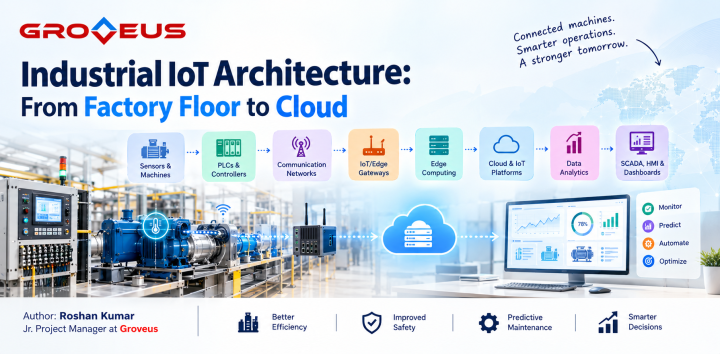
Learn how Industrial IoT architecture connects machines, PLCs, sensors, edge systems and cloud platforms for monitoring, automation and predictive maintenance.
When we talk about Industrial IoT, we are not talking about sensors only. A factory already has machines, PLCs, controllers and industrial networks. IIoT brings these pieces together so that the information generated on the factory floor can actually be used.
The architecture starts with sensors and machines. Data then moves through PLCs, communication networks and gateways before reaching edge systems or cloud platforms. At other end, analytics, SCADA systems and dashboards turn that data into something operators can understand and act on.
For us, the important part is not only connecting equipment. It is creating a useful flow of information between the physical operation and the digital systems around it.
What Is Industrial IoT (IIoT)?
Industrial IoT, commonly called IIoT, means connecting industrial machines, sensors, PLCs and software so they can collect and exchange operational data.
A temperature reading, motor vibration, pressure value or energy reading may look like an isolated number. Once these readings are collected over time and put into context, they can tell us quite a lot about the health and performance of equipment.
That is where IIoT becomes useful. It can support equipment monitoring, process automation, predictive maintenance and better operational decisions.
IoT vs IIoT: Why Industrial Systems Are Different
The word IoT is used broadly but an industrial environment has very different requirements. A smart home device can tolerate a delay. A production machine may not have that luxury.
The Layers of an Industrial IoT Architecture
An IIoT system is easier to understand when we break it into layers. Each layer has a job, and the layers need to work together properly.
Sensors & Actuators:
Sensors collect information, while actuators carry out physical actions.PLCs & Controllers:
These handle machine logic and industrial process control.Communication Networks:
Protocols such as Modbus, OPC UA and MQTT move information between systems.IoT/Edge Gateways:
Gateways connect industrial equipment with modern IoT platforms.Edge Computing:
Data can be processed close to the machine when a quick response is needed.Cloud & IoT Platforms:
These provide storage, management and larger-scale processing.Data Analytics:
Machine readings are converted into useful operational insights.SCADA, HMI & Dashboards:
Operators get a clear view of equipment and processes.
How Data Travels Through an IIoT System
A sample setup will look like this:
Machine/Sensor --> PLC --> Modbus/OPC UA --> Edge Gateway --> MQTT --> Cloud --> Database --> Analytics/Dashboard

The actual arrangement will depend on the machinery, protocols, network and business requirement. There is no need to make every factory architecture identical.
Edge vs Cloud Processing
One question comes up quite often: should industrial data be processed at the edge or sent directly to the cloud?
In practice, both can have a place.
Edge computing is useful when a machine needs an immediate response. Cloud platforms are more suitable for storing and analysing large amounts of information over time.
Industrial IoT Communication Protocols
Industrial equipment does not always use the same communication method. That is why protocol selection becomes an important part of the architecture.
The right choice depends on what the existing machines support and what the new system needs to achieve.
IIoT Cybersecurity Architecture
Connecting machines also creates another responsibility: keeping those machines and the data around them protected.
An IIoT security plan should not depend on a single firewall or password. We look at security across the different layers of the system.
Security layers:
Device Security:
Protect sensors, PLCs, gateways and controllers.Network Security:
Use firewalls, segmentation, VPNs and secure communication where appropriate.Access Control:
Restrict systems through authentication and role-based permissions.Data Security:
Protect information while it is being transmitted and stored.Edge & Cloud Security:
Secure edge devices, APIs and cloud platforms.Monitoring & Response:
Watch for unusual activity and respond to potential threats.

Reliability and High Availability
A factory cannot afford to treat reliability as an afterthought. If a connected system becomes another source of downtime, it has missed the point.
Redundancy:
Backup devices and network paths reduce single points of failure.Failover:
Moves operations to a backup system when the primary one fails.Real-Time Monitoring:
Helps identify equipment and network problems quickly.Edge Processing:
Allows critical functions to continue when cloud connectivity is unavailable.Predictive Maintenance:
Uses machine information to identify possible failures earlier.24/7 Operation:
Supports industrial processes that need continuous availability.
Integrating Legacy Industrial Equipment
Many factories still depend on machines that have been running for years. Replacing all of them simply to introduce IIoT may not make commercial sense.
Fortunately, there are other options.
Protocol Gateways:
Translate older protocols such as Modbus or PROFIBUS into newer communication formats.IoT Gateways:
Collect information from older machines and pass it to edge or cloud systems.Sensors:
External sensors can provide data when the machine itself does not expose it digitally.Edge Computing:
Filters and processes machine data locally.Non-Invasive Integration:
Allows equipment to be monitored without changing its core control system.Result:
Existing equipment can become part of a modern monitoring and analytics setup without a complete replacement.
Real-Time Monitoring and Predictive Maintenance
This is one of the areas where IIoT can make a visible difference on the factory floor. Instead of waiting for a machine to fail, teams can keep an eye on readings such as temperature, vibration, pressure and energy consumption.
Real-Time Monitoring:
Tracks machine performance and operating conditions.Condition Monitoring:
Highlights unusual equipment behaviour.Predictive Analytics:
Combines historical and current data to identify possible failures.Early Alerts:
Gives operators a warning before a serious problem develops.Planned Maintenance:
Helps teams decide when maintenance should be scheduled.Benefits:
Can reduce unexpected failures, downtime and unnecessary maintenance work.
Example IIoT Factory Architecture: Tea Factory
We have a practical example within our own work: Groveus A.R.T.S. (Automatic Rolling Table System).
The system takes a traditional tea rolling table and adds automation around the rolling process. It manages the rolling-pressure sequence, uses sensors for protection, handles recovery after a power cut and alerts workers before the process finishes.
Example data/control flow:
Tea Rolling Table ? Sensors ? Controller ? Motor/Actuator ? Rolling Sequence ? Alerts & Monitoring
This is a good example of what we mean by practical IIoT. The technology is built around an actual production requirement, rather than adding connectivity simply because it is available.
Common IIoT Deployment Challenges
Getting the first machine connected is only one part of the project. Scaling the system across a working factory can bring a different set of problems.
Legacy Equipment:
Older machines may need gateways, adapters or additional sensors.Cybersecurity:
Connected industrial devices need proper protection.Protocol Compatibility:
Different machines may communicate in different ways.Data Management:
Real-time systems can generate large amounts of information.Network Reliability:
Industrial connectivity needs to remain dependable.High Initial Cost:
Sensors, gateways, software and infrastructure require investment.Scalability:
The architecture should not become difficult to expand later.Skilled Workforce:
IIoT projects often require knowledge across automation, networking, software and analytics.
Best Practices for Production Deployment
We generally prefer starting with a clear operational problem instead of trying to digitise everything at once.
Start Small:
Test the idea through a pilot before expanding it.Secure Every Layer:
Protect devices, networks, gateways and cloud systems.Use Standard Protocols:
Use suitable standards such as OPC UA, MQTT and Modbus where applicable.Process Data at the Edge:
Keep time-sensitive processing close to the equipment.Ensure Reliability:
Build in backups, redundancy and failover where required.Monitor Continuously:
Keep track of machine health, network status and system performance.Plan for Scalability:
Leave room for additional machines, sensors and data.Document Everything:
Record devices, configurations, networks and processes clearly.
Future of Industrial IoT
IIoT is moving towards systems that do more than collect information. They are increasingly expected to interpret that information and help people make decisions.
AI & Machine Learning:
Better predictive maintenance and automated decision-making.Edge AI:
Faster analysis directly near industrial equipment.Digital Twins:
Virtual representations that can help with monitoring and optimisation.5G & Industrial Wireless:
New options for machine connectivity.Smart Factories:
More connected and automated production environments.Advanced Robotics:
Robots can increasingly work as part of connected industrial systems.Energy Optimisation:
Data can help identify opportunities to reduce energy consumption.Autonomous Operations:
Systems can increasingly detect conditions and respond with less manual intervention.
Conclusion
Industrial IoT is ultimately about making industrial data useful. A sensor by itself only gives us a reading. It’s real value appears when that reading can move through right systems, reach the right person and support a right decision.
That mean detecting a machine problem early, understanding why production has slowed, recovering a process after a power interruption or studying months of equipment data to plan maintenance.
At Groveus, we approach industrial technology from the problem first. We look at the machinery, the existing setup and the process before deciding where IoT, automation, edge computing or analytics can actually help.
The factories of the future will certainly be more connected. But connectivity alone is not the destination. The real goal is a factory that can understand what is happening and respond intelligently.
Comments 0