

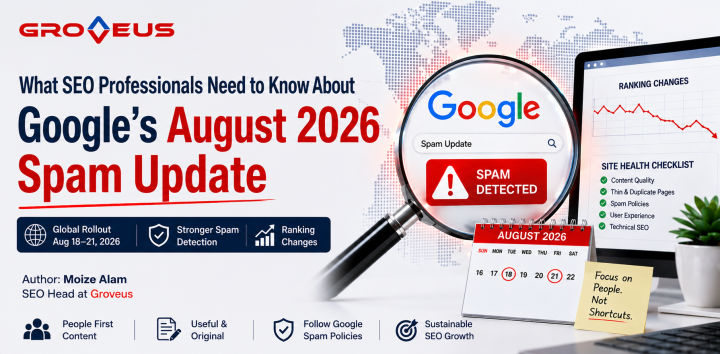
Google's August 2026 Spam Update ended August 21. Learn what changed, why rankings moved and what SEO professionals should do next.
What SEO Professionals Need to Know About Google’s August 2026 Spam Update
Google’s August 2026 Spam Update finished rolling out on August 21, 2026, after starting on August 18. The global rollout covered all languages and regions and, according to Google’s Search Status Dashboard, took about 2 days and 16 hours to complete.
This was a Spam Update, not a broad Core Update. That difference matters. Google was mainly improving how its systems find and deal with websites or practices that go against its existing spam policies.
So, if your rankings moved in these few days, don’t assume that your entire SEO strategy has become wrong. First, look at what changed?actually.
What Was the August 2026 Google Spam Update?
The update started on August 18, 2026 and was completed on August 21. Google mentioned it as a normal spam update with a worldwide rollout.
There was no announcement of an entirely new spam policy. The change was more about how Google’s systems detect and enforce the policies that already exist.
That is an important point for website owners.
A ranking drop does not automatically mean Google has marked the website as spam. Search visibility can move for several reasons, so making large changes immediately after an update is usually not the best first step.
Look at the data first.
Why Did Rankings Change?
There was noticeable movement in search results during the update. Data from Search Engine Ranking, reported by Search Engine Land, found that 16.71% of URLs that had previously been in Google’s top 10 moved beyond the top 100 in update period. While in a comparable period without a confirmed update, the figure was 9.2%.
That is a sizeable difference.
It suggests that the August update caused more ranking movement than normal.
Sites that depend heavily on repetitive pages, low-value content, misleading practices, automatically produced material or other spam-like methods can become more exposed when Google improves its detection systems.
Does Google Penalize AI-Generated Content?
Not simply because it was created with AI.
The bigger question is what the content actually does for the reader. Is it useful? Is there something original in it? Does it answer the query properly? Does it show real knowledge of the subject?
A website can create poor content manually, just as it can create useful content with AI assistance.
The problem starts when AI is used to produce large amounts of pages mainly for search traffic, with little attention to usefulness or originality. Repeating same ideas across dozens of pages, changing only a few keywords or locations is not a strong long-term SEO approach.
AI can still be part of a sensible content workflow. Human review, genuine expertise, a clear reason for publishing the page matter much more than tools used to write the first draft of content.
What Should SEO Professionals Do After the Update?
If traffic or rankings changed between August 18 and August 21, resist the temptation to rebuild the whole website immediately.
Start with Google Search Console.
Look at:
clicks and impressions before and after the update
keywords that gained or lost positions
pages with the biggest traffic changes
crawling and indexing problems
thin or duplicate pages
excessive keyword targeting
repetitive or automatically generated content
internal links and the overall usefulness of important pages
Then look at Google’s existing spam policies and compare them with your site.
This is also where page-level analysis helps. A website may lose visibility on a few weak pages while its important pages remain stable. Treating the entire domain as a problem in that situation can lead to unnecessary changes.
And if the site is following Google’s guidelines already and genuinely helping visitors, there is no need to make changes for only because a spam update has finished.
What Does the August Update Mean for AI-Assisted SEO?
For SEO teams using AI, the lesson is fairly straightforward. Using AI is not the strategy. What you publish with it is the strategy.
A useful workflow can still involve AI for research, outlining, content planning, keyword grouping or editing. But the finished page should have a reason to exist beyond targeting another search phrase.
That means adding information that is actually useful, removing repeated sections, checking factual claims and bringing in genuine subject knowledge where it is available.
This becomes even more important when a website has many location or service pages. Changing the city name in an otherwise identical article does not create strong local content.
Final Thoughts on Google’s August Spam Update
The Google August 2026 Spam Update is another reminder that sustainable SEO is difficult to build around shortcuts.
The rollout ran globally from August 18 to August 21, 2026, with a reported duration of around 2 days and 16 hours.
For businesses and SEO professionals, the sensible response is not panic. Check the numbers, find the pages that actually lost visibility, and then work out why.
Focus on useful content, a good user experience, sound technical SEO, genuine expertise and compliance with Google’s spam policies.
The simplest rule still holds: build pages for people first, and don’t make search-engine manipulation the main reason a page exists.
Comments 0