

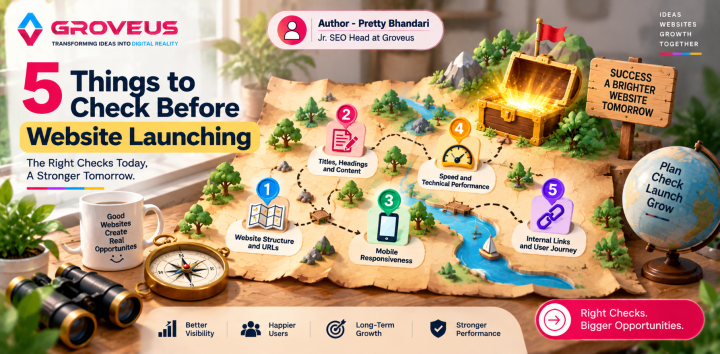
Planning a website launch? Discover 5 essential SEO checks for structure, content, mobile responsiveness, speed, technical performance, and internal links.
Website launching is a crucial step; however, going live doesn't mean that everything is finished. There are several issues which require attention prior to letting visitors use the website and search engines start crawling it.
A brief check will help to identify some problems which may remain unnoticed once the website goes live.
Here are five aspects which should be checked before the website goes live.
1. Website Structure and URLs
First of all, let's have a look at website structure.
Are visitors able to get to the major pages easily? Are URLs descriptive and understandable? Do related pages have meaningful links to each other?
A reasonable website structure will allow making navigation easier. Moreover, it will provide useful hints for search engines about the relevance and importance of the webpages.
URLs shouldn't contain meaningless numbers and words. Major pages should be accessible via website navigation or proper internal links.
2. Titles, Headings and Content
Content of each page should be provided for a certain reason.
Check titles, headings and the text on the page. Does it match the content? Moreover, does it meet the expectations of the visitors?
This is a good moment to identify duplicated content, thin pages, lacking headings or sections which don't bring any benefit.
It's not necessary to cram a keyword into each sentence. Usually natural content which describes the page properly is much easier to read.
3. Mobile Responsiveness
A website can look beautiful on a computer monitor and still have some issues on smartphones.
Try to open the website on various screen sizes and check the important pages in terms of:
Text readability
Clickable elements
Image positioning
Navigation menu
Interaction forms
Accessibility of important content
Nobody wants to pinch and zoom just to read a text or click a button. The mobile website should be designed in a way it looks like a regular website, not just a downscaled version of the website for desktop computers.
4. Speed and Technical Performance
Slow pages can make users frustrated; therefore, website performance requires checking before going live.
Large images are one of the first things to look at. Unused scripts, excessive CSS and other unnecessary files can also increase the page load time.
Besides the page load time, SEO technical setup should also be reviewed at this step. It's important to check if the pages are crawlable and indexable, if the canonical tags are used correctly, if the redirects work properly and so on.
Also, it is worth checking XML sitemap and finding possible broken links before the website goes public.
5. Internal Links and User Journey
Finally, it's time to consider the website from a visitor's perspective.
After visiting one page, where can the visitor proceed further?
For instance, a service page can be followed by another service, a location page or an informative article. Creating such links will increase the exploration of the website.
Internal links are beneficial for SEO purposes; however, they shouldn't be the only reason to create them. It is necessary to put a link where it can help a visitor to find some relevant information.
Conclusion
The website launching process is not limited to publication of the final version.
Website structure, content, mobile usability, performance and technical SEO setup all require checking before the website goes live. Proper handling of these aspects at the early stage will save a lot of time from SEO and usability issues.
At Groveus Informatics Pvt. Ltd., SEO is considered as a part of website development, not an additional phase after the website is finished.
A beautifully designed website may attract visitors' attention.
The website which is easy to use, fast to load, useful for visitors and convenient for search engines to index has better chances to be successful.
Comments 0